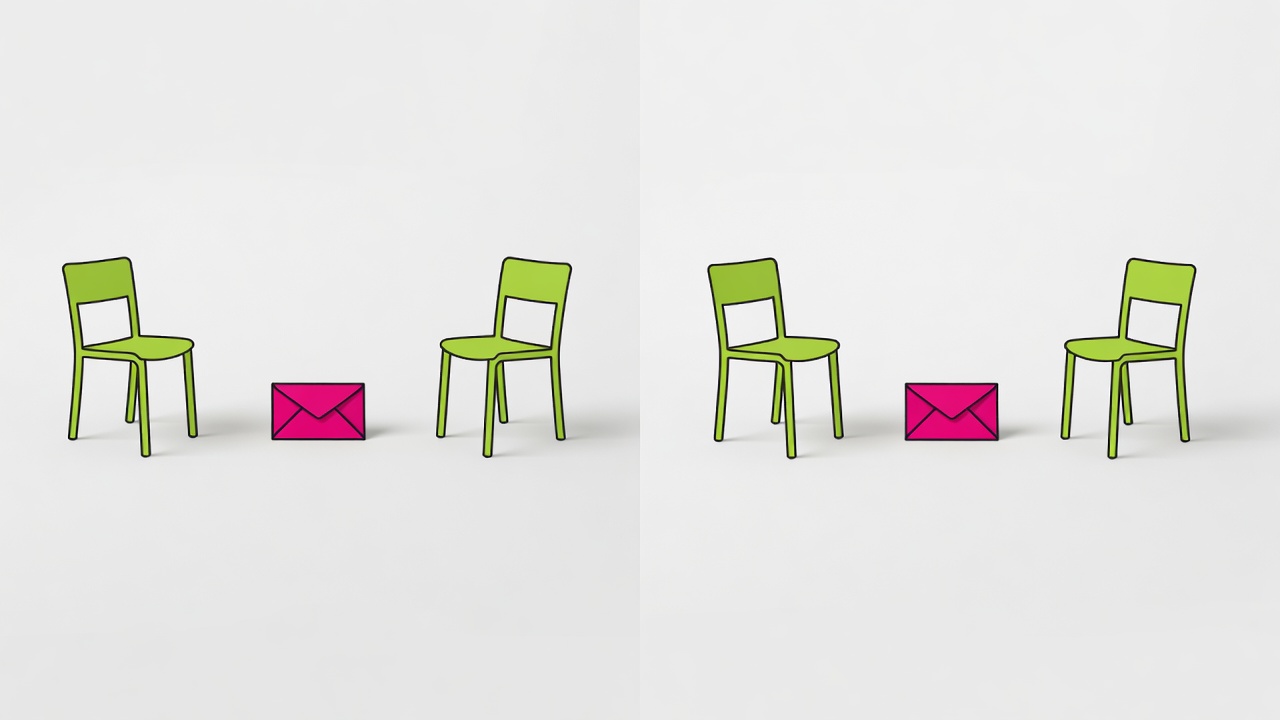
Define what changes
At the start of our invented scene, Mara wants her brother Leon to leave before he asks about the letter. By the end, she makes room for him to sit. The movement is small, but the immediate objective has changed. This gives the scene a turn even if the audience never learns what the envelope contains.
A short film does not need a reversal in which every apparent fact becomes false. A decision, recognition or change in relationship can organize an ending. Ask what the audience can now reasonably expect that they could not expect before. Here, a conversation has become possible. Forgiveness, agreement and reconciliation remain beyond the evidence.
Distinguish a turn from a twist
A turn changes the direction or conditions of the action. A twist substantially revises how we understand information. They can happen together, but they are not identical. Discovering that Leon returned the letter unread could revise Mara’s assumptions; choosing to move the chair would show what she does with that discovery.
If the film ends only on the new fact, viewers may experience surprise without witnessing a consequence. That can be a deliberate design, but it is worth testing a version with one additional action. A hand withdrawing, a door remaining open or a bag being set down can show the revelation entering the relationship rather than remaining an abstract piece of information.
Plant evidence with more than one use
An earned reveal often makes an earlier detail newly legible. Suppose the envelope’s seal is clearly visible but not emphasized. At first it establishes the object. Later, when Leon says he did not read the letter, the intact seal supports his claim. The detail has served the immediate scene without existing only as a conspicuous clue.
Fairness depends on the film’s storytelling contract. An unrestricted viewpoint that strategically avoids the obvious can feel manipulative. A tightly limited viewpoint may honestly leave the same information unavailable. Ask whose access organizes the scene and whether the final disclosure respects that access. Surprise should not require viewers to forget what they were plainly shown.
Give the choice a cost
Moving a chair matters more if the film has made clear why Mara resisted doing so. Perhaps sitting down means postponing a departure she has prepared for. Perhaps it exposes her to a question she cannot answer. The cost need not involve danger or catastrophe. It only needs to make the action more than a neutral adjustment of furniture.
Avoid inflating the backstory with explanations the scene cannot support. One practical detail may be enough: a coat already on, a key in hand, a waiting taxi heard outside. The decisive action can then interrupt an established trajectory. The audience sees what the character gives up, even if only for a few minutes.
Let the ending answer the right question
If the opening invites us to wonder whether Leon will be allowed into the room, the moved chair can provide a satisfying local answer. If the opening strongly promises the contents of a mysterious letter, withholding them may feel like evasion instead. Endings are judged partly against the expectations the film itself cultivates.
An open ending is not simply an ending with missing information. It can resolve an immediate action while leaving a larger consequence unsettled. “Will they speak?” may be answered; “Can they repair the relationship?” may remain open. Identify the level at which closure occurs before calling the film unfinished.
Return to an image with a difference
Our scene begins with two chairs separated across a table. Ending on a comparable wide frame allows viewers to measure the altered arrangement. The repeated image gives memory a concrete anchor. Keep enough features stable that the changed element is noticeable, but do not assume symmetry alone produces meaning.
Albert Lamorisse’s The Red Balloon and the Lumière production commonly known as L’Arroseur arrosé offer very different short-form viewing references for action, expectation and consequence. They are not templates for our invented scene. Alfred Hitchcock’s Rear Window, a feature, can supply a separate comparison for how limited access shapes audience knowledge. Clearly distinguish short-film examples from feature-film comparisons when making an argument.
Test the turn without its explanation
Describe the scene as three actions: she blocks the chair; he returns the sealed letter; she makes room. If the sequence remains intelligible, dialogue can add texture rather than rescue a missing causal link. If it becomes unclear, inspect which observation or relationship the audience lacks. More explanation is not always the best fix; a clearer setup may do more.
Different viewers may still disagree about what Mara’s final gesture means. One might see generosity, another a cautious attempt to control the terms of the encounter. A durable ending can support that disagreement while making the visible change unmistakable. Precision in action and openness in interpretation can coexist.