Hear the literal exchange first
Mara says, “You’re early.” Leon answers, “The bus was empty.” In our invented scene, these lines establish an arrival and a practical explanation. That literal function matters. If we leap immediately to hidden hostility, we can overlook the useful information the exchange supplies. A reading becomes stronger when it accounts for what the words plainly communicate as well as what they might avoid.
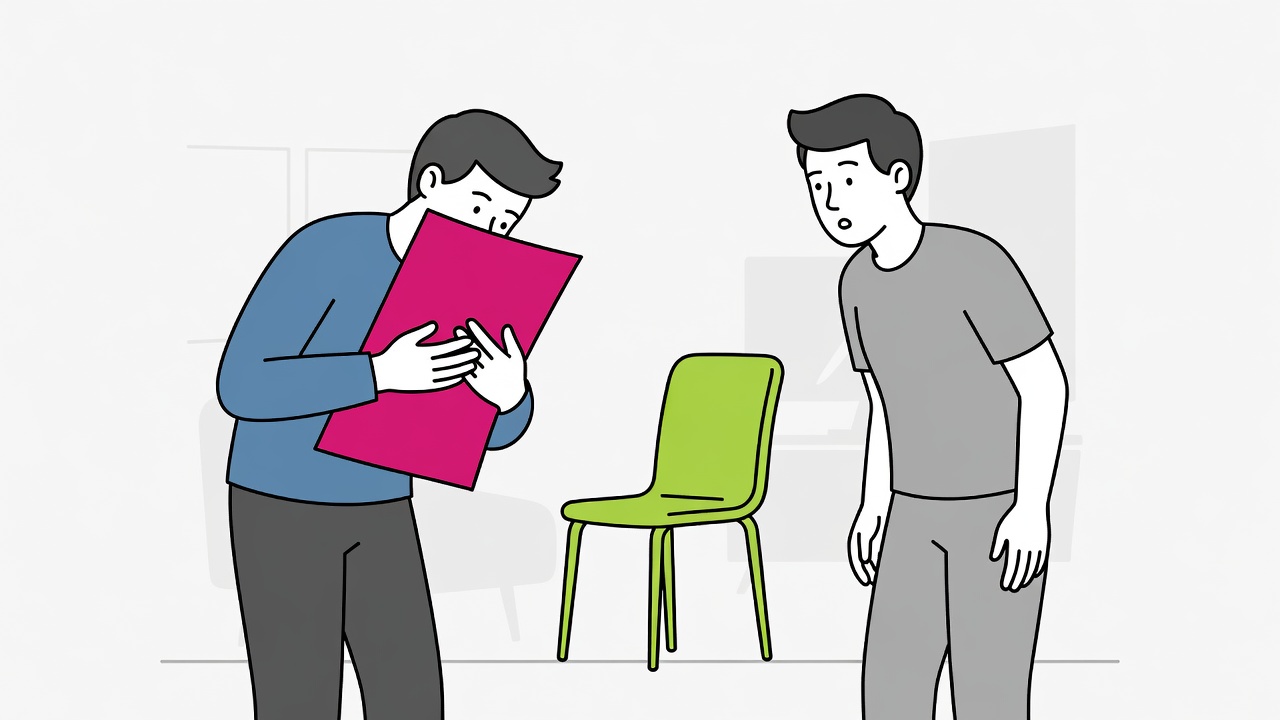
Now add the visible action: Mara covers the unopened letter with her hand before speaking. Her line may be an attempt to regain time or control. Leon looks at the hand, then answers about the bus. His response might deliberately leave the letter unmentioned. It might also be an innocent answer to the question he thinks she asked. The performance and the surrounding scene should help us distinguish those possibilities.
Ask what each character wants now
An immediate objective is more playable than a general emotional label. “Be sad” gives an actor little practical direction. “Keep him from asking about the envelope” describes an action with resistance built into it. For Leon, “Get her to let me sit down” creates something specific to pursue, even if the larger relationship remains unresolved.
Objectives can shift within a very short exchange. Once Mara realizes Leon has already seen the letter, concealment may become explanation. Once Leon is offered the chair, entry may become the wish to stay. Character development does not require a speech declaring personal growth. A changed tactic, supported by an observable choice, can make a modest but meaningful movement visible.
Annotate pressure, not secret thoughts
- Line: “You’re early.” Action: Mara covers the envelope. Possible tactic: delay the conversation.
- Line: “The bus was empty.” Action: Leon stays in the doorway. Possible tactic: answer without pushing.
- Line: “You can put your bag down.” Action: Mara moves the second chair. Possible shift: permit a longer encounter.
These annotations are hypotheses, not access to a character’s private mind. A useful alternative might read Mara’s covered hand as protection of Leon rather than concealment from him. Compare what happens next. Does she prevent him from seeing the letter, or does she turn it toward him? Later actions can strengthen or weaken an early inference.
Give silence an observable shape
Silence is not automatically profound. Specify what fills it: breathing, a refrigerator hum, a bag strap sliding from a shoulder, a gaze that does not meet another gaze. The length of a pause matters in relation to the tempo already established. A delay that feels conspicuous after rapid replies may feel ordinary in a scene built around patient observation.
For a practical exercise, record the same exchange with an immediate reply, a reply after the speaker looks down, and a reply after the listener begins to leave. Compare the resulting actions rather than declaring one version more emotional. The purpose is to discover what each timing allows the audience to notice.
Watch the person who is listening
A reaction shot need not confirm that the listener understands. Leon might hear an invitation where Mara intended a practical instruction. Keeping the listener in frame can let us compare spoken intention with received meaning. Cutting away too quickly may remove the moment when that difference becomes visible.
Konstantin Stanislavski’s work on acting offers a historical route into objectives and actions, while Sanford Meisner’s teaching is associated with attention to a scene partner and responsive behavior. These are distinct traditions, not interchangeable recipes. Screen analysis can borrow questions from performance practice without claiming to know which technique an actor used.
Let dialogue share the storytelling work
A short film has limited time, but that does not mean every line must serve several conspicuous purposes. Sometimes a simple practical sentence gives viewers room to notice a gesture. Exposition becomes awkward when characters tell each other facts they already know solely for the audience’s benefit. Look for a reason the information must be spoken at this moment.
For broader context, Charlie Chaplin’s The Immigrant demonstrates how much an encounter can communicate without synchronized spoken dialogue. Agnès Varda’s Cléo from 5 to 7, a feature rather than a short, offers another comparison for attention to talk, waiting and self-presentation. Use such comparisons to sharpen questions, not to rank spoken storytelling below visual storytelling. Words are part of the image-and-sound event too.