Track the question between images
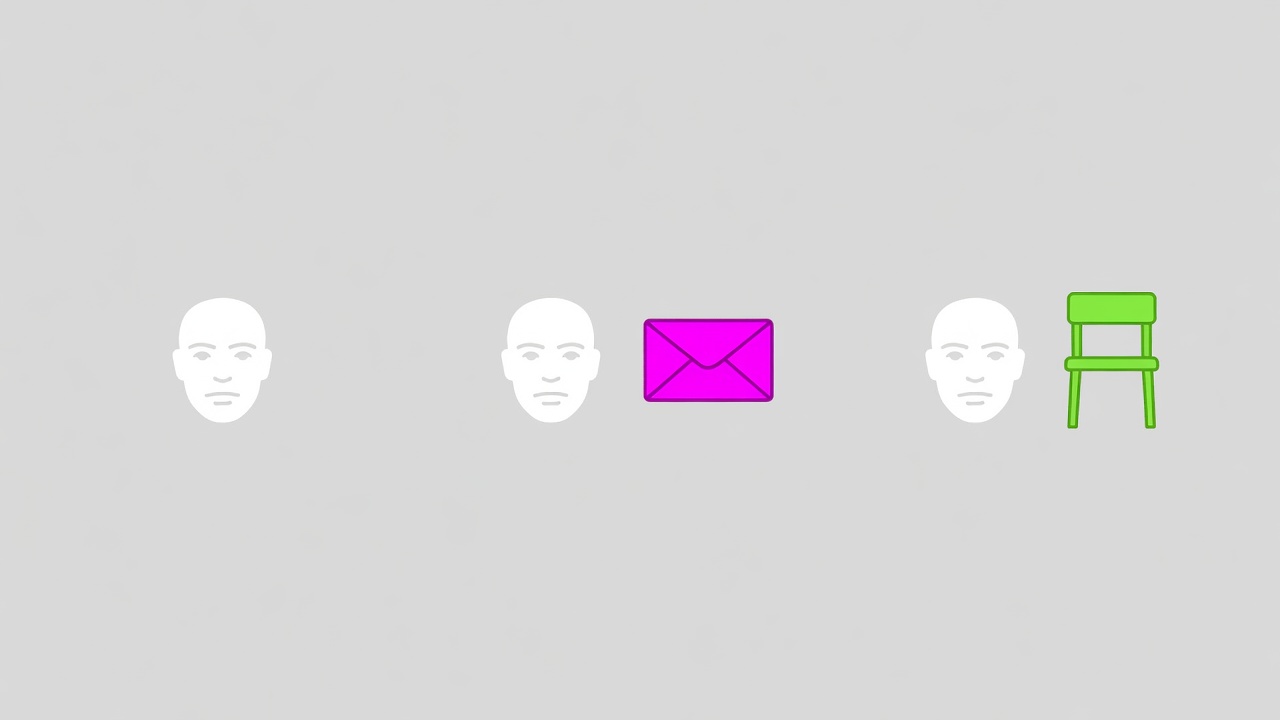
In our invented scene, Mara looks toward the table. Cut to an unopened envelope and viewers may connect her attention to a message. Cut instead to an empty chair and the same look may seem concerned with someone’s absence. Neither sequence proves what she thinks. Each supplies a different object around which the audience can organize an inference.
This is a useful starting point for understanding relational editing: meaning can emerge from the relationship between shots rather than residing entirely inside either image. Lev Kuleshov is closely associated with demonstrations and accounts of this principle. The historical experiments are often simplified in retelling, so treat the familiar example as an introduction to a question, not a universal scientific guarantee of audience response.
Compare two orders of the same material
Cut A
Letter → look → chair
The letter establishes a possible concern. The look registers attention. The chair then introduces a possible response or next action.
Cut B
Look → chair → letter
The look first creates uncertainty. The chair appears to answer it. The letter arrives later and may make that answer feel incomplete.
Keep the images and their durations identical for your first comparison. Otherwise, a change in order becomes tangled with a change in pace. Then alter one duration and watch again. This simple experiment helps emerging editors distinguish the effect of a neighboring image from the effect of the time available to examine it.
Cut for a shift in attention
A cut can follow a movement, but it can also follow a change in what matters. When Leon says, “I didn’t read it,” the most useful next image might not be Leon finishing the sentence. It might be Mara’s hand releasing the envelope. The cut directs us toward a consequence of the words rather than toward their source.
Walter Murch’s In the Blink of an Eye discusses editing through priorities that include emotion, story and rhythm. It is a practitioner’s account, not a formula that can automatically choose the right frame. Use it to ask what a cut preserves and what it gives up. Perfectly matched movement can be less important than retaining a fragile performance beat, depending on the scene’s purpose.
Distinguish speed from dramatic rhythm
Many cuts do not necessarily create urgency. Rapidly alternating similar images can feel repetitive if no information changes. A long-held wide shot can feel urgent when the viewer is waiting for someone to cross the room. Rhythm involves expectation, variation and event density as well as shot length.
In the letter scene, hold the opening arrangement long enough to establish the empty chair. The later movement of that chair can then register as a change. If the opening disappears too quickly, the audience may understand the action but miss the comparison. Timing is partly about allowing the relevant information to become available.
Listen across the cut
A sound bridge continues a sound across an image change. A J-cut introduces the next scene’s sound before its image; an L-cut lets the previous scene’s sound continue over the next image. These terms describe arrangements, not guaranteed effects. Hearing Leon’s bag hit the floor before seeing him sit could make the decision to stay arrive through sound first.
Be attentive to room tone, the quieter background sound that helps a space feel continuous. A sudden change may be expressive, but it may also be an unintended edit seam. Do not assume that every audible discontinuity carries a narrative intention. Separate what you hear from a claim about why the filmmakers left it there.
Use continuity as support, not a cage
Matching action, screen direction and eyelines can help viewers follow a scene with little effort. Deliberately breaking those patterns can produce a different experience. Sergei Eisenstein’s writings on montage and Vsevolod Pudovkin’s writings on film construction offer influential, distinct approaches to relationships among shots. Neither reduces editing to invisible continuity.
For a contrasting viewing exercise, Chris Marker’s La Jetée makes an especially useful study of image duration, narration and still photographs. It is an existing film, not a demonstration we created. Watch through an authorized source, identify one transition precisely, and explain what changes in your understanding. That is more valuable than calling an entire sequence “powerful editing.”