Begin with the arrangement
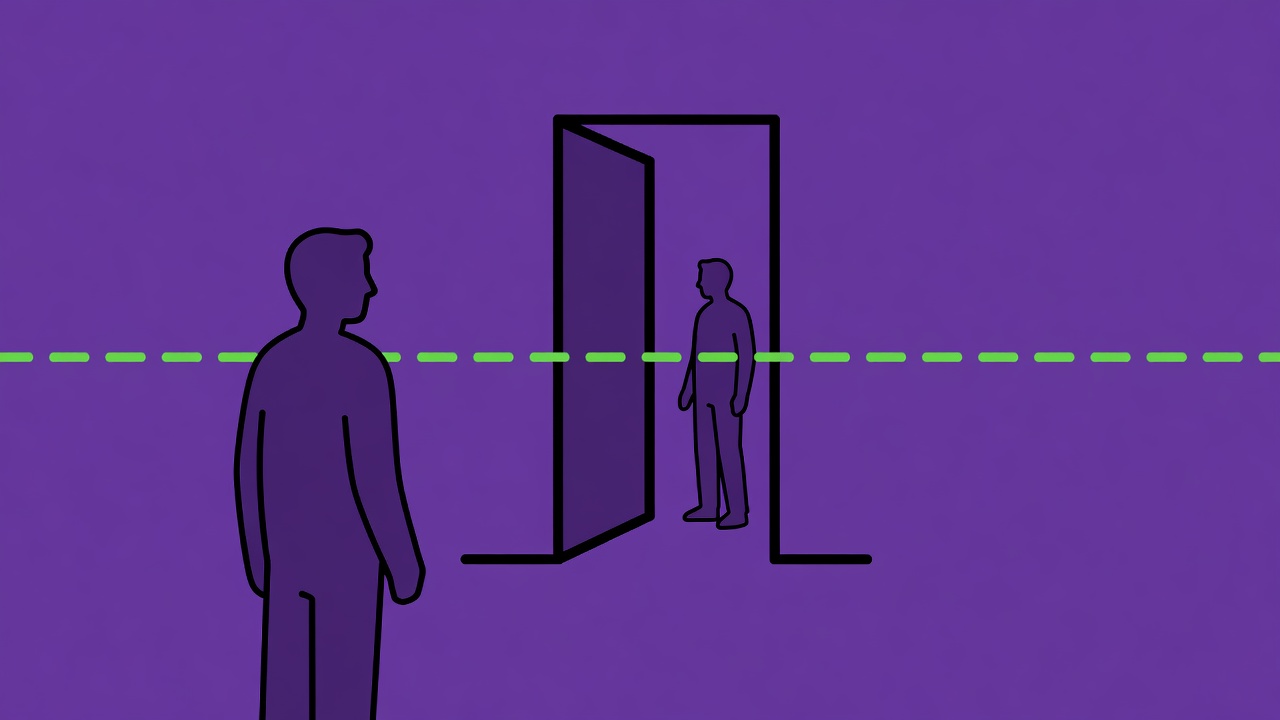
In our invented short-film scene, Mara waits beside a table while her brother Leon stands just outside the room. An unopened letter rests between two chairs. Mara occupies the left foreground; Leon appears smaller in the doorway. Before interpreting the image, describe it: two figures, unequal apparent size, a vertical boundary and an object neither touches. These observations give your reading something firmer than an immediate impression of “cinematic tension.”
The image may suggest that Mara controls access to the room. It could also suggest that Leon is leaving rather than arriving. The next action matters. When he steps forward and she moves a chair into his path, the blocking makes an obstacle explicit. When she moves it aside, the same doorway can become an invitation. Composition gains meaning through change, not only through a single attractive arrangement.
Look at negative space as usable space
Negative space is the area around and between the elements attracting our attention. It need not represent loneliness. In this scene, the empty patch beside Mara could prepare us for Leon to enter it. Holding that area open gives his eventual movement a destination. If the camera instead fills the frame with Mara’s face, the room becomes less available as dramatic information.
Ask what the empty area permits the film to show later. A second character might enter, a door might close, or nobody might move at all. An unfulfilled spatial expectation can be meaningful, but only if the film gives us a reason to anticipate the change. Avoid treating every blank wall as evidence of alienation.
Separate camera angle from camera distance
A low camera angle looks upward; a close shot brings the subject nearer within the frame. They are different choices and can work in different directions. A low-angle close shot might make a face imposing, but it might also emphasize a character’s uncomfortable exposure beneath a ceiling light. A wide shot can diminish someone or give them room to act freely.
Describe the actual relationship: how much of the body is visible, where the camera sits, what occupies the background and which other figures remain present. Focal length, camera distance and set depth interact. Do not diagnose a particular lens from a finished image unless reliable production information supports that claim. Describe the visible perspective instead.
Follow blocking through the whole beat
Blocking is the arrangement and movement of performers in the scene. Watch feet, shoulders and occupied pathways as well as faces. Leon may turn toward the exit while keeping his eyes on Mara. That divided orientation can make departure feel possible without requiring a line announcing it. Mara’s response might be to move, speak or remain still.
For emerging filmmakers, try staging the exchange in a wide frame before planning close coverage. If a meaningful shift is legible through bodies and space, the close shots can refine it rather than carry every piece of information. Keep practical access and performer comfort in mind; a convincing screen obstacle should not become an unsafe physical one.
Make the eyelines readable
An eyeline tells us where a character appears to look. A cut from Mara looking down to the letter encourages a connection between them. A slightly different look might imply the empty chair instead. Establish enough geography that viewers can understand the intended relationship, especially when the object of attention is outside the current image.
Continuity conventions, including the 180-degree system, can help preserve orientation across shots. They are tools, not laws of emotional truth. Crossing the established axis can be clear if movement or a wider view reorients us. If you choose disorientation, ask whether it supports the scene or merely makes the action difficult to follow.
Compare without copying a master
Buster Keaton’s One Week offers a useful starting point for studying how bodies, architecture and readable wide staging interact. Maya Deren and Alexander Hammid’s Meshes of the Afternoon offers a different route into domestic space and shifting perception. Chantal Akerman’s Saute ma ville invites attention to a performer’s relationship with a confined interior. These are existing films, not sources for our invented letter scene.
Watch an authorized version and record a specific observation before borrowing an interpretation. David Bordwell and Kristin Thompson’s Film Art: An Introduction provides vocabulary for this kind of formal attention. The British Film Institute is another starting point for film context and criticism. Neither vocabulary nor reputation replaces looking at the actual image.